All Tribes Treasures
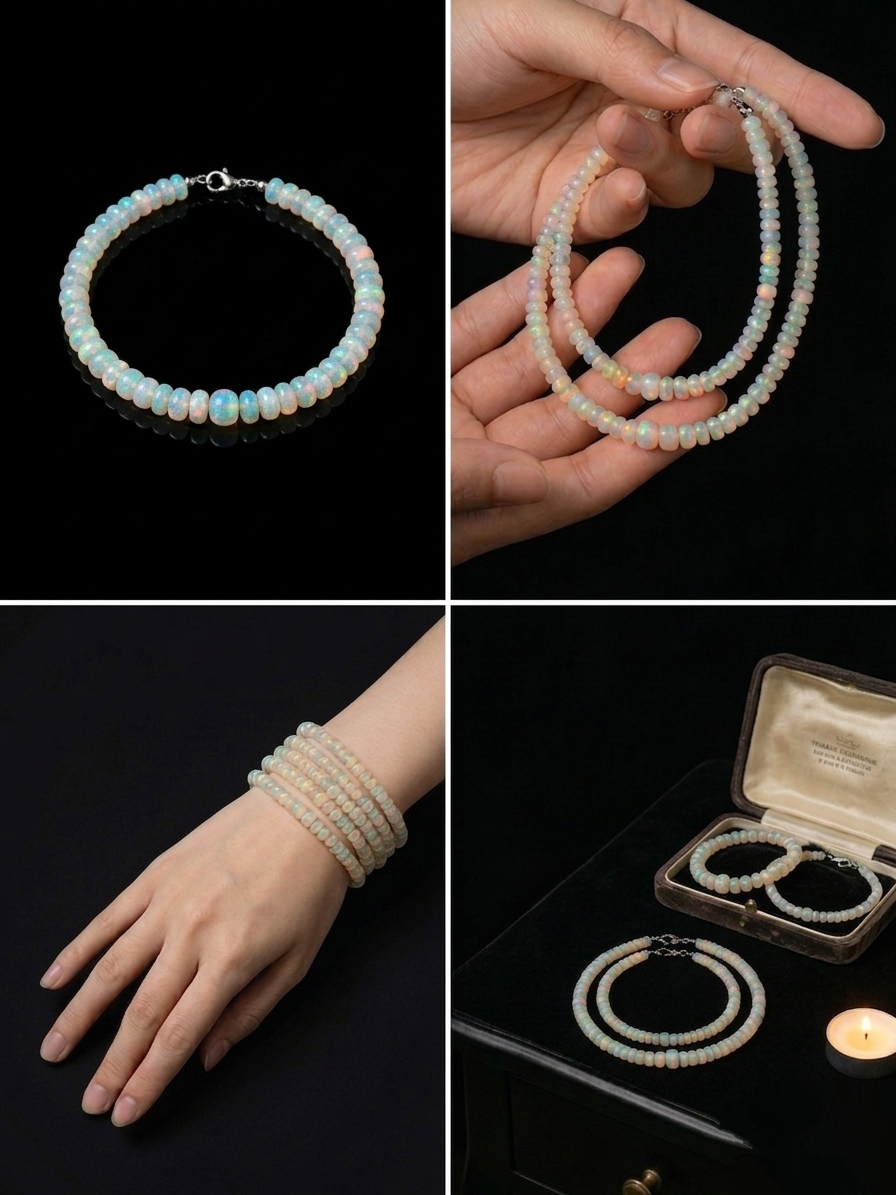
Australian White Opal Graduated Rondelle Bracelet | Natural Prismatic Fire | Sterling Silver Clasp
Australian White Opal Graduated Rondelle Bracelet | Natural Prismatic Fire | Sterling Silver Clasp
Couldn't load pickup availability
✦ Natural Australian White Opal Graduated Rondelle Bracelet
Grade: B+ to A– | Origin: Australia | Price: $59.95
These bracelets are strung from natural Australian white opal rondelles — the classic "white opal" or "light opal" of the gem trade, sourced from the opal fields of South Australia and New South Wales. Each bead is hand-selected and high-polished, displaying the characteristic milky-white to translucent body tone that makes Australian opal the world standard for this gem.
What sets these apart is the play-of-color: prismatic flashes of blue, green, violet, and warm amber-orange dance across the surface — some stones leaning toward the fiery orange hues reminiscent of Mexican fire opal, while others glow with a cool, Milky Way iridescence. No two bracelets are identical.
✦ Gem Specifications
- Gemstone: Natural Australian White Opal (Light Opal / Milky Opal)
- Bead Shape: Irregular high-polish graduated rondelles (disc/wheel cut)
- Bead Size: Graduated — 2mm thick × 4mm wide at ends, graduating to 4mm thick × 8mm wide at center
- Grade: B+ to A– (natural, untreated; minor surface irregularities consistent with natural opal)
- Clasp: Sterling silver lobster claw
- Length: ~6 inches (one-size-fits-most bracelet)
- Treatment: None — 100% natural
✦ The Opal Difference: What You're Wearing
Australian white opal is classified as "light opal" by the Gemological Institute of America (GIA) — defined by a white, grey, or crystal body tone with a visible play-of-color. The phenomenon you see is called opalescence or play-of-color, caused by microscopic silica spheres diffracting light into spectral colors. Opal is not a crystal — it is an amorphous hydrated silica (SiO₂·nH₂O), meaning it contains up to 20% water within its structure.
Australia produces approximately 95% of the world's precious opal, with major fields at Coober Pedy, Lightning Ridge, and White Cliffs. The graduated rondelle cut used here is a traditional lapidary shape — flat, disc-like beads that maximize the face-up play-of-color while keeping the stone lightweight for jewelry. The graduation from smaller beads at the clasp to larger beads at the center creates a naturally flattering drape on the wrist.
✦ Birthstone & Astrological Associations
- Birthstone: October (alongside tourmaline) — official modern birthstone per the American Gem Society
- Zodiac: Libra (Sep 23 – Oct 22) and Scorpio (Oct 23 – Nov 21)
- Anniversary: Traditional 14th and 18th wedding anniversary gemstone
- Element: Water
✦ Metaphysical & Spiritual Properties
Opal has been revered across cultures for millennia as a stone of vision, amplification, and emotional truth.
- Amplification: Opal is considered a karmic stone — said to amplify emotions and intentions, making it a powerful tool for intentional inner work.
- Creativity & Inspiration: Long associated with artists, writers, and visionaries; said to stimulate originality and dynamic energy.
- Emotional Release: White opal is linked to the crown and heart chakras, supporting clarity, compassion, and the release of old emotional patterns.
- Protection: Ancient Romans called opal "Cupid Paederos" and believed it carried the powers of all gemstones combined. Medieval Europeans wore it as a talisman of good luck and protection.
- Spiritual Sight: Many traditions associate opal with the third eye — enhancing intuition, psychic awareness, and dream recall.
- Water Energy: As a hydrated stone, opal resonates with the flow of water — adaptability, emotional fluidity, and cleansing.
✦ Historical & Cultural Notes
- The word opal derives from the Sanskrit upala ("precious stone") and the Greek opallios ("to see a change of color").
- Pliny the Elder (1st century AD) wrote that opal surpassed all other gems because it contained "the fire of the carbuncle, the brilliant purple of the amethyst, and the sea-green of the emerald, all shining together in incredible union."
- Aboriginal Australians have sacred creation stories involving opal — in Andamooka Dreaming, the Creator descended to Earth on a rainbow, and where his feet touched the ground, the stones came alive with color.
- Queen Victoria was a devoted opal collector and gifted Australian opals to each of her daughters, helping reverse a superstition that opal was unlucky.
✦ Care Instructions
Opal contains water — avoid prolonged exposure to heat, dry air, ultrasonic cleaners, or harsh chemicals. Wipe gently with a soft damp cloth. Store separately from harder stones to prevent surface scratching.
Share